Dismiss Modal

Types

Understanding Heart Valves

Choose a preferred language

The heart has four valves. They are the aortic, pulmonary, tricuspid, and mitral valves. The valves open and close to keep blood moving in the right direction through the heart. Blood moves through the heart as it beats. With each squeeze, the valves open and close to keep blood moving forward. In this way, valves keep blood moving as well as possible through the heart. They also prevent backflow.
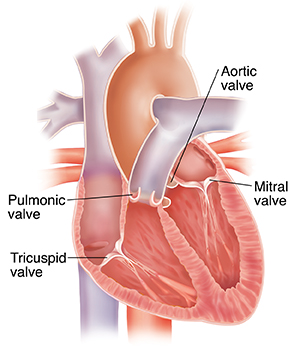
Cross section of heart showing four valves.

When the heart relaxes between beats:

  • Oxygen-rich blood from the lungs fills the left atrium.

  • Oxygen-poor blood from the body fills the right atrium.

When the atria beat:

  • The left atrium squeezes. This pushes blood through the mitral valve into the left ventricle.

  • The right atrium squeezes. This pushes blood through the tricuspid valve into the right ventricle.

When the ventricles beat:

  • The left ventricle squeezes. This pushes blood through the aortic valve out to the heart arteries, the brain, and body.

  • The right ventricle squeezes. This pushes blood through the pulmonary valve to the lungs.
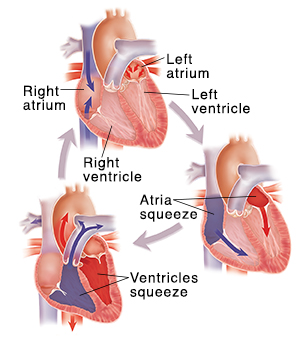
Diagram of three cross-sectioned hearts showing blood flow during heartbeats.

© 2000-2026 The StayWell Company, LLC. All rights reserved. This information is not intended as a substitute for professional medical care. Always follow your healthcare professional's instructions.
Related Articles
Read article
Heart Health
Understanding Left Ventricular Hypertrophy (LVH)

Left ventricular hypertrophy (LVH) is an enlarged heart.

Read article
Heart Health
Brugada Syndrome

Brugada syndrome is a genetic disorder that causes an irregular heartbeat. This rare, but life- threatening condition is more common in people of Asian descent.

Read article
Heart Health
Understanding Coronary Microvascular Disease

Coronary microvascular disease (CMD) is also sometimes called small artery or small vessel disease. It occurs when the inner blood vessels of the heart become damaged. In some cases, the small arteries of the heart don’t function properly.

Read article
Heart Health
Right-Sided Heart Failure

Swelling in the feet and ankles is one of the first signs of right-sided heart failure. Learn how this condition is treated.