Good posture helps protect you from injury. It also increases your comfort. Aim for good posture throughout the day.
Check your posture
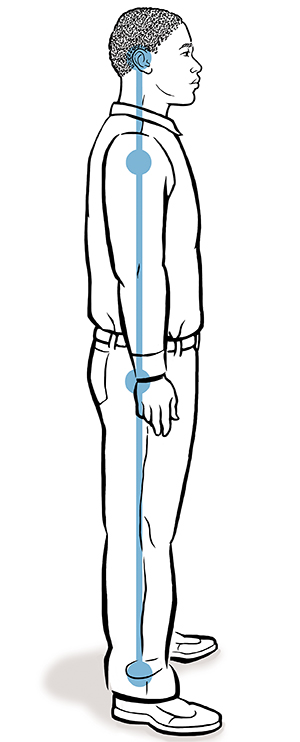
The human body works best when it's correctly aligned. To improve your standing posture, follow these steps:
-
Take a moment to close your eyes and feel your body. Then breathe deeply and relax your shoulders, hips, and knees.
-
Lift up just a bit from the very top of your head. Think of a line linking your ears, shoulders, hips, and ankles. Adjust your body to follow the line. You may need to relax your hips and tuck your buttocks under a bit.
-
Next, take a look at yourself in a mirror. Is one ear, shoulder, or hip higher than the other? They should be level.
Check how you sit
When you sit correctly, pressure on your back is reduced. Try these steps:
-
Sit so that the curve of your lower back fits easily against the chair. Keep your gaze level.
-
Support your feet. They should be flat on the floor or on a footrest. Your knees should be level with your hips.
-
Adjust the chair height as needed. Sit so your forearms are level with the work surface.
Correct posture helps
When your back is aligned, it’s more likely to stay safe throughout the day.
-
Standing in place. Rest one foot on a stool or low box to ease pressure on your lower back. Switch feet often. If you can, adjust the height of your work surface so your neck and shoulders aren’t under strain.
-
Driving. Sit close enough to the steering wheel to keep your knees slightly bent. For comfort, your knees should be level with your hips or just a bit lower. Sit as straight as you can. The curve of your lower back should be fully supported.
-
Walking. Stand tall and walk with your head up. Let your arms swing while you walk. This helps relax muscles. Wear shoes that fit and support your feet. If you'll be standing or walking for a long time, don’t wear high heels.
-
Sitting and sleeping. Choose your furniture with care. Make sure it’s not causing or increasing your back pain. Chairs should allow for comfortable, correct sitting posture. Use pillows for added support if needed. Your bed should support your back’s natural curves without being too hard or too soft.

Orthopedics CTA
Find a DoctorRelated Articles
Leg Cramps
A muscle cramp or spasm is a strong contraction of the muscle fibers.
Kneecap Surgery: Removing Damaged Cartilage
Surgery may be used when pain severely limits your activities. Or it may be done when a rehab program or other nonsurgical treatments just are not helping enough. Some procedures may be done using arthroscopy. This method uses tiny incisions and special instruments to look and work inside the knee joint. Other procedures need open surgery.
Understanding Clavicle Fracture Open Reduction and Internal Fixation (ORIF)
Open reduction and internal fixation (ORIF) is a type of treatment to fix a broken bone. It puts the pieces of a broken bone back together so they can heal.
Discharge Instructions: Using a Cold Water Therapy Device
Your doctor prescribed a cold water therapy device. This device helps reduce pain and swelling and aids recovery. Here's what you need to know about home care.