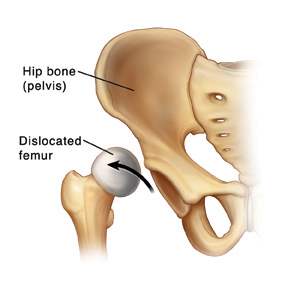
The hip is a ball-and-socket type of joint. After a hip replacement surgery, the muscles and ligaments that normally keep the hip in place are made weaker. The ball of the new hip is more easily forced out of its position in the socket. This is called a dislocation. This is the most common problem after hip replacement surgery.
Your hip joint has been put back in place. This is called a reduction. But you are at risk for another dislocation. Dislocations can damage the implant. Follow the advice below to prevent this. Exercises to make leg muscle stronger may help prevent another dislocation. Your health care provider may suggest these once you have no pain and can walk without crutches.
If you have had a few dislocations, it may be helpful to have another surgery to reposition the implants or to insert new implants. You can talk about these choices with your orthopedic surgeon.
Home care
-
Follow your health care provider's advice about weight bearing and using crutches or a walker.
-
Take pain medicine as directed.
-
Don't cross your legs.
-
Don't bend forward from the hips more than 90°. Be careful to stay away from low seats, sofas, and toilets.
-
Try using crutches or a walker if your provider approves. Ask your provider when this is safe. A physical therapist may also help with your recovery.
Follow-up care
Follow up with your health care provider as advised.
Call 911
Call
-
Leg becomes pale or cold
-
Numbness or weakness in the affected leg
-
Shortness of breath or chest pain
-
Dizziness, weakness, or fainting
When to get medical advice
Contact your health care provider if any of these occur:
-
Increasing hip pain or deformity
-
Increasing swelling, redness, or pain of the lower leg

Orthopedics CTA
Find a DoctorRelated Articles
Understanding Clavicle Fracture Open Reduction and Internal Fixation (ORIF)
Open reduction and internal fixation (ORIF) is a type of treatment to fix a broken bone. It puts the pieces of a broken bone back together so they can heal.
Splints and Casts
Splints and casts are used to help support and protect a variety of bone and soft tissue injuries. They keep an injured area from moving.
RICE
RICE stands for rest, ice, compression, and elevation. These actions may be recommended for fractures, sprains, strains, and bruises or bumps.
Your Amputation Surgery
Amputation is surgery to remove a limb. Learn about the surgery and what to expect after.