Osgood-Schlatter disease is a condition that affects the knee most often in active, growing teens. You likely have pain and swelling below the kneecap. This is where the patellar tendon attaches to the shinbone (tibia). Osgood-Schlatter disease won't cause lasting problems and it will go away on its own once you stop growing. But your symptoms and pain will need to be treated until then. How soon your knee gets better is up to you. To help your knee heal, try resting and icing it.
If you still have pain, your health care provider may have you wear a special padded knee strap.
Giving your knee a rest
You can rest your knee and make changes to the way you do things to reduce your pain. To know how much you should rest the knee, let pain be your guide. If you feel a lot of pain, stay off the knee as much as you can. Don't run, jump, walk up or down stairs, kneel, or do activities that cause pain. If you do sports, you may be able to continue if the pain goes away when you rest your knee. If your pain is mild, try swimming, cycling, or other sports that don’t put as much stress on the knee. As the pain gets less, ease back into your normal routine.
If you are active in sports, here are a few suggestions that can help in your recovery:
-
Limit how much you participate in sports to reduce knee strain.
-
Ease back into doing sports gradually.
-
Use the appropriate sports equipment and methods.
-
Keep your hamstring and quadicep muscles flexible by doing strength training and stretches.
Reducing pain and swelling
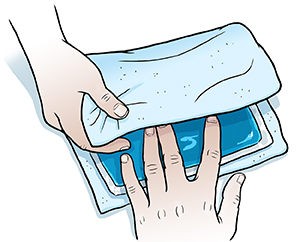
If the pain and swelling really bother you, try icing your knee for 10 to 15 minutes a few times a day. Wrap the ice pack in a towel before putting it on the affected area. Do not apply the ice pack directly to the skin as it may cause ice burns.
You can try over-the-counter medicine, such as ibuprofen, to help reduce swelling. Ask your health care provider what kind of medicine to take. Don't take medicine that contains aspirin. Aspirin is dangerous for anyone who’s not an adult.
If you still have pain, your provider may suggest physical therapy.
Wearing a knee strap
Your health care provider may give you a special padded knee strap to wear. This kneepad protects the knee from direct trauma. It can ease some of the pressure on your knee. You can wear it when playing sports and even when just walking around. Wear the strap right below your kneecap but above the bump formed by the tibial tubercle. Padding can also help with irritation to the area.
If your problem is severe
Sometimes, resting your knee isn’t enough to make it better. You may need more medical treatment. Immobilization is a type of treatment that keeps you from moving the knee. You may need to wear a brace or a cast for a few weeks. Talk with your health care provider about the right knee brace for you and for instructions on how to use it.
If you use a knee brace, you’ll also need to walk with crutches. Later, you’ll need to regain flexibility and strength in your knees and legs. You can then ease into your normal routine. But if your knee hurts, rest it until you feel better.
There is no evidence to recommend injection therapy or surgery for Osgood-Schlatter disease.
When to call the health care provider
After a few weeks of self-care, your knee should feel better. But let your provider know if the pain gets worse, or if it doesn't go away with rest.
Orthopedics CTA
Find a DoctorRelated Articles
Knee Osteotomy
Knee osteotomy is surgery to shift the positioning of the knee. Read this to learn about the surgery and the recovery.
Microdiskectomy
During a microdiscectomy, some disk is removed. In most cases, bone must first be removed to expose the damaged disk. The part of the disk outer wall and soft center that presses on the nerve can then be removed. There is usually enough disk remaining to cushion the vertebrae.
Kneecap Surgery: Removing Damaged Cartilage
Surgery may be used when pain severely limits your activities. Or it may be done when a rehab program or other nonsurgical treatments just are not helping enough. Some procedures may be done using arthroscopy. This method uses tiny incisions and special instruments to look and work inside the knee joint. Other procedures need open surgery.
Understanding Clavicle Fracture Open Reduction and Internal Fixation (ORIF)
Open reduction and internal fixation (ORIF) is a type of treatment to fix a broken bone. It puts the pieces of a broken bone back together so they can heal.