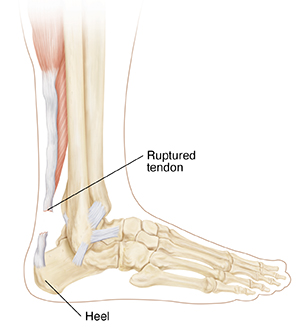
Your Achilles tendon is a large band of tissue in the back of your ankle. It connects your calf muscles to your heel bone. The tendon helps you point your foot down, rise on your toes, and push off when you walk. You use it almost each time you move your leg. But repeated stress can make the tendon more prone to injury. It may become inflamed and develop small tears (tendonitis). A complete tear through the tendon is called an Achilles tendon rupture.
When to go to the emergency room (ER)
Get medical care right away if you:
-
Hear a loud pop or snapping sound
-
Have the feeling of being hit hard in the back of the leg
-
Are not able to stand on your toes, bend your foot downward, or walk normally
A ruptured Achilles tendon may not cause a lot of pain. So if you hear a loud pop, get medical care. Do this even if you can walk and don`t have pain.
What to expect in the ER
A healthcare provider will examine your feet, ankles, and legs. They are likely to ask about your physical activities. You may tests. These could include an MRI scan. This detailed imaging test uses magnets and a computer to make a clear picture of the tendons. An ultrasound may also be done. Ultrasound uses sound waves to create an image of the injured area.
Your treatment
If your tendon has ruptured, you will be referred to an orthopedic surgeon or a primary care sports healthcare provider. They will discuss your treatment choices with you. These include surgery to fix the tendon. Or wearing a cast or boot and using crutches until the tendon heals.

Orthopedics CTA
Find a DoctorRelated Articles
Kyphosis
A spine affected by kyphosis has a forward curvature of the back bones (vertebrae) in the upper back area, giving an abnormally rounded or humpback appearance.
Understanding Osgood-Schlatter Disease
Osgood-Schlatter disease is a painful knee problem that can happen in active young people. It almost always gets better with rest and simple treatment.
Rib Contusion or Minor Fracture
A rib fracture (bone break) may cause the same symptoms as a rib contusion. Treatment for both is the same.
De Quervain Tenosynovitis
De Quervain tenosynovitis is inflammation of tendons and synovium on the thumb side of the wrist. Learn how to care for this condition at home.