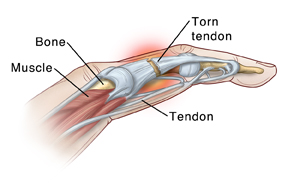
Tendons are cordlike fibers that connect muscles to bones. The flexor and extensor tendons help control movement in your fingers. A tear (rupture) of one or more of these tendons can cause pain, swelling, bruising, and bleeding. Depending on the type of tendon injured and the degree of the injury, you may be unable to bend or straighten the affected finger.
X-rays are often taken to look for injury to bones. A splint or cast may be applied to the affected finger to hold it in position. If the injury is severe, surgery may be needed to reattach the torn ends of the tendon. In this case, a hand surgeon may be recommended for surgical evaluation and treatment.
Hand exercises or physical therapy may also be recommended. These can help reduce stiffness or loss of movement in the finger after the tendon heals.
Home care
Follow these guidelines when caring for yourself at home:
-
Put a cold pack on the injured area 3 or 4 times a day for 15 to 20 minutes at a time. To make an ice pack, put ice cubes in a plastic bag that seals at the top. Wrap the bag in a clean, thin towel or cloth. Never put ice or an ice pack directly on the skin. The cold pack can be put right on the cast or splint. As the ice melts, be careful that the cast or splint doesn’t get wet. Use the cold pack until pain and swelling get better.
-
To help with pain and swelling, keep your hand raised above the level of your heart. When you sit or lie down, put your hand on a pillow that rests on your chest or on a pillow at your side.
-
Care for your splint or cast as instructed. If you have a splint, wear it as directed. If you don't use it correctly, your finger will not heal correctly.
-
When bathing, keep your splint or cast well out of the water. Protect it with a large plastic bag, with rubber bands at the top end. If a fiberglass splint or cast gets wet, you can dry it with a hair dryer.
-
Do any finger and hand exercises as instructed.
Follow-up care
Follow up with your health care provider as advised. Physical therapy (PT) is often recommended after a flexor tendon injury. Ask your provider about PT.
When to get medical advice
Contact your health care provider right away if:
-
You have a fever of 100.4°F (38°C) or higher, as directed by your provider.
-
You have chills.
-
Pain or swelling gets worse.
-
Your finger or hand becomes cold, blue, numb, or tingly.

Orthopedics CTA
Find a DoctorRelated Articles
Coccyx or Sacrum Bruise (Contusion)
A contusion of the coccyx or sacrum causes swelling and some bleeding under the skin. This injury generally takes a few weeks to heal. Read on for details about how to care for yourself.
Closed Toe Fracture
Toe fractures cause local pain, swelling, and bruising. These injuries take about 4 weeks to heal. Toe injuries are often treated by taping the injured toe to the next one. This protects the injured toe and holds it in position.
Foot drop
Foot drop is a disorder that makes it hard to raise the foot at the ankle. There may also be pain, weakness and numbness in the foot.
Closed Hand Fracture (Adult)
You have a fracture, or broken bone, in your hand. This may be a small crack or chip in the bone. Or it may be a major break with the broken parts pushed out of place. A closed fracture means that the broken bone has not gone through the skin.