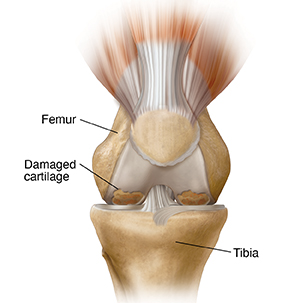
A joint is a place where two bones meet. The knee is called a hinge joint. This joint is formed where the thighbone (femur) meets the shinbone (tibia). A healthy knee joint bends freely. Knee osteoarthritis is a condition where parts of the knee joint wear out. This can lead to pain, stiffness, and limited movement.
What is osteoarthritis?
Every joint contains a smooth tissue called cartilage. Cartilage cushions the ends of bones and helps bones in a joint glide smoothly against each other. Knee osteoarthritis occurs when cartilage in the knee joint starts to break down and wear away. Bones may become exposed and rub together. The cartilage may become irritated and rough. This prevents smooth movement of the joint and can lead to pain.
Causes of osteoarthritis of the knee
Causes can include:
-
Wear and tear from normal use over time, especially in older adults.
-
Repeated stress or overuse of the knee during sports or work activities.
-
Being overweight. This increases stress on the knee joint.
-
Misalignment of the knee joint.
-
Injury to the knee.
-
Inflammatory arthritis. This can cause a secondary osteoarthritis.
-
Gout or pseudogout. This can cause a secondary osteoarthritis.
-
Genetics. Your genes can affect when osteoarthritis starts and how severe it is.
Symptoms of osteoarthritis of the knee
Common symptoms include:
-
Pain and swelling around the joint. The pain and swelling get worse with activity and better with rest.
-
A grinding sound when you move the knee.
-
Reduced knee movement.
-
Knee stiffness. This is often worse first thing in the morning.
Treating osteoarthritis of the knee
Osteoarthritis is a long-term condition. Treatment is done to manage symptoms. It may include:
-
Medicines taken by mouth to help relieve pain and swelling.
-
Injections of medicine into the joint to help relieve symptoms for a time.
-
A weight-loss plan for people who are overweight.
-
A plan of physical therapy and exercises. These can improve the strength and flexibility of the muscles around the knee.
-
Heat or cold therapy to help relieve pain and stiffness.
-
Devices that help with movement, such as a cane or a walker.
-
Devices that make daily tasks easier, such as raised toilet seats or shower bars.
If other treatments don’t help to relieve symptoms, you may need surgery. This is done to replace the joint. During this surgery, the damaged knee joint is removed. An artificial knee joint is then put into place. This can help relieve pain and stiffness and restore movement of the knee.
When to call your doctor
Contact your doctor right away if you have:
-
A fever of 100.4°F (38°C) or higher, or as directed by your doctor.
-
Symptoms that don’t get better with prescribed medicines or that get worse.
-
New symptoms.
Author: Michels, Karen
© 2000-2026 The StayWell Company, LLC. All rights reserved. This information is not intended as a substitute for professional medical care. Always follow your healthcare professional's instructions.
Orthopedics CTA
Find a DoctorRelated Articles
Understanding Lateral Epicondylitis
This condition, also called tennis elbow, is an inflammation around the bony knob (lateral epicondyle) on the outer side of the elbow. It occurs when the tissue that attaches muscle to the bone becomes irritated.
Understanding Lumbosacral Strain
Lumbosacral strain is a medical term for an injury that causes low back pain. The lumbosacral area (low back) is between the bottom of the ribcage and the top of the buttocks. A strain is tearing of muscles and tendons.
Rib Contusion or Minor Fracture
A rib fracture (bone break) may cause the same symptoms as a rib contusion. Treatment for both is the same.
Open Finger Fracture
You have a broken finger (fracture) with a nearby cut, puncture, or deep scrape. This causes local pain, swelling, and bruising. Because of the open injury, you are at risk for infection in the skin and bone. You will take antibiotics to lower the risk for infection.