Shoulder impingement syndrome is a problem with the shoulder joint. It occurs when certain parts in the joint swell and are pinched. This can cause nagging pain and problems with moving the arm.
What causes shoulder impingement syndrome?
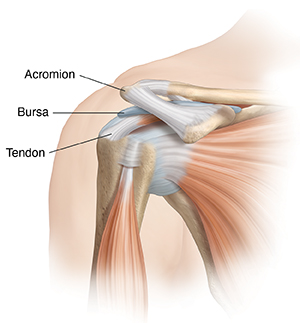
It's possible to develop impingement after years of normal shoulder use. But in most cases, the condition occurs because of repeated overhead movements. These include such things as stocking shelves, painting, swimming, and throwing. These movements can irritate parts of the shoulder, leading to swelling. Swollen parts of the shoulder take up more room, making the joint space smaller. Some parts that may be affected include:
-
A sac of fluid (bursa) that cushions the shoulder joint. When the bursa is irritated, it may lead to a condition called bursitis. This is when the bursa swells with fluid, filling and squeezing the joint space.
-
Fibrous tissues (tendons) that connect muscle to bone. When tendons are irritated, they may become swollen. This is called tendonitis.
-
The end (acromion) of the shoulder blade. This bone may be flat or hooked. If the acromion is hooked, the joint space may be smaller than normal. Growths (bone spurs) on the acromion can also narrow the joint space. Acromion problems don’t often cause impingement. But they can make it worse.
Symptoms of shoulder impingement syndrome
Symptoms include pain, pinching, or stiffness in your shoulder. Pain often comes with movement, particularly reaching overhead or backward. It may also be felt when the shoulder is at rest. Pain at night during sleep is common.
Treatment for shoulder impingement syndrome
Treatment will depend on the cause of the problem, how bad the problem is, and if other parts of the shoulder are damaged. Treatment may include the following:
-
Active rest. This lets the shoulder heal. It means using the arm and shoulder, but not doing activities that cause pain. These likely include reaching overhead or sleeping on your shoulder.
-
Cold packs. These help reduce swelling and ease pain.
-
Prescription or over-the-counter medicines. These help relieve pain and swelling. NSAIDs (nonsteroidal anti-inflammatory drugs) are the most common medicines used. Medicines may be prescribed or bought over the counter. They may be given as pills. Or they may be put on the skin as a gel, cream, or patch.
-
Arm and shoulder exercises. These help keep your shoulder joint mobile as it heals. They also help improve muscle strength around the joint.
-
Shots of medicine into the joint. This can help reduce swelling and pain. The medicine used is usually a corticosteroid. This is a strong anti-inflammatory medicine.
If other measures don’t work to ease symptoms, you may need surgery. This opens up space in the joint to allow pain-free motion.
Possible complications of shoulder impingement syndrome
It might be tempting to stop using your shoulder completely to prevent pain. But doing so may lead to a condition called frozen shoulder. To help prevent this, follow instructions you're given for active rest and for doing exercises to help your shoulder heal.
When to call your healthcare provider
Call your healthcare provider right away if you have any of these:
-
Fever of 100.4°F (38°C) or higher, or as advised by your provider
-
Chills
-
Symptoms that don’t get better, or get worse
-
New symptoms
Author: Michels, Karen
© 2000-2026 The StayWell Company, LLC. All rights reserved. This information is not intended as a substitute for professional medical care. Always follow your healthcare professional's instructions.
Orthopedics CTA
Find a DoctorRelated Articles
Knee Sprain
A sprain is an injury to the ligaments or capsule that holds a joint together. Here's how to care for yourself at home.
Understanding Lateral Epicondylitis
This condition, also called tennis elbow, is an inflammation around the bony knob (lateral epicondyle) on the outer side of the elbow. It occurs when the tissue that attaches muscle to the bone becomes irritated.
Understanding Osgood-Schlatter Disease
Osgood-Schlatter disease is a painful knee problem that can happen in active young people. It almost always gets better with rest and simple treatment.
Rib Contusion or Minor Fracture
A rib fracture (bone break) may cause the same symptoms as a rib contusion. Treatment for both is the same.