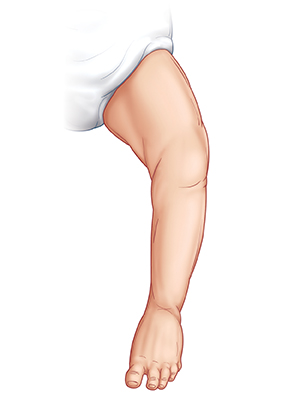
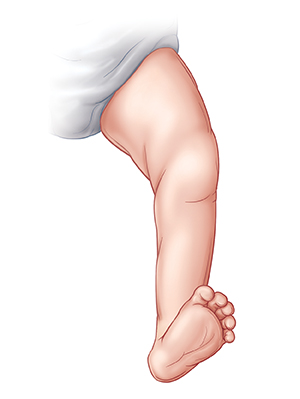
Your child was born with calcaneovalgus. This is a problem with the shape of the foot (deformity). The foot points upward and outward. In extreme cases, the top of the foot touches the front of the lower leg. The condition is congenital, meaning your child was born with it. It may affect one or both feet. Calcaneovalgus causes the baby no pain and often goes away on its own.
What are the causes of calcaneovalgus?
The main cause is thought to be squeezing of the foot due to the child’s being “packed” in the uterus during the last few months of pregnancy. Calcaneovalgus runs in families. It occurs more often in girls than boys.
How is calcaneovalgus diagnosed?
Calcaneovalgus is easily found by looking at the foot when the child is born. The healthcare provider will check for other congenital foot deformities.
How is calcaneovalgus treated?
Calcaneovalgus most often goes away on its own. But any child with a foot deformity should be evaluated by a healthcare provider to make sure it's not a more serious condition. It can be hard to treat this problem in an older child. So it's best if the child is diagnosed as an infant. Here's what you can expect:
-
For mild cases. The healthcare provider will prescribe stretching exercises to be done at each diaper change. The parent gently moves the foot down and in for a count of 10, repeating the stretch 3 times.
-
For moderate cases or when stretching doesn't correct the condition. The healthcare provider may prescribe splints or firm, high-top, lace-up shoes. These hold the foot in the correct position.
-
For severe cases. The healthcare provider may prescribe casting of the child’s legs and feet for up to several months. The casts move the child’s foot into normal position. Casts are changed every 1 to 2 weeks. Surgery is needed only if the foot was pushed up enough to bend the shin bone backward, which is rare.
What are the long-term concerns?
-
If diagnosed and treated, the child’s foot often works well and looks normal.
-
If it doesn’t go away, calcaneovalgus can cause problems with muscle development, leg length differences, and walking. Your child should see their healthcare provider for regular follow-up visits to be sure the problem goes away.
Featured in

Orthopedics CTA
Find a DoctorRelated Articles
Osteogenesis Imperfecta in Children
Osteogenesis imperfecta (OI), or brittle bone disease, is a genetic disorder present at birth. It causes soft, easily fractured bones, abnormal bone formation, and other issues. Symptoms vary from mild to severe.
Bowlegs (Child)
Bowlegs means that the legs bend outward from the knees to the ankles.
Clubfoot in Children
Clubfoot is a deformity of the foot. It's when one or both feet are turned inward. The condition affects the bones, muscles, tendons, and blood vessels. Clubfoot is present at birth. Learn more about clubfoot in children, including what the symptoms are and how it is treated.
Greenstick Fracture of the Leg (Child)
A greenstick fracture is when one side of the bone cracks and the other side bends without any break. This is a very common fracture in children because their bones are softer. Learn how to care for your child at home after a greenstick fracture of the leg.