Gender words are used here to talk about anatomy and health risk. Use this information in a way that works best for you and your doctor as you talk about your care.
The urethra is the tube that runs from the bladder through the penis. When the urethra is inflamed, it is called urethritis. The urethra can become swollen and cause a burning feeling or pain when you urinate. Other symptoms of urethritis in men may include itching or tingling of the penis, or pus discharge from the penis. You may also have pain with sex and masturbation. Sometimes there are no symptoms.
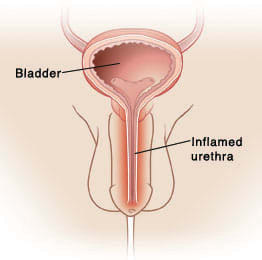
What causes urethritis?
Urethritis can be caused by a bacterial or viral infection. Such an infection can lead to conditions, such as a urinary tract infection (UTI) or a sexually transmitted infection (STI). Urethritis can also be caused by an injury or a sensitivity or allergy to chemicals in lotions and other products.
How is urethritis diagnosed?
Your doctor will examine you and ask about your symptoms and health history. You may also have one or more of these tests:
- Urine test. This is done to take urine samples and have them checked for problems.
- Blood test. A blood sample is taken and checked for problems.
- Urethral discharge culture. A fluid sample is taken from inside the urethra and checked under a microscope. To get the sample, a cotton swab is inserted into the opening of the penis and into the urethra.
- Cystoscopy. This test lets the doctor look for problems in the urinary tract. The test uses a thin, flexible tube (cystoscope). It has a light and camera attached. The scope is inserted into the urethra.
How is urethritis treated?
Treatment depends on the cause of urethritis. If it's from a bacterial infection, medicines that fight infection (antibiotics) will be given. Your doctor can tell you more about your treatment choices.
In the meantime, your symptoms can be treated. To ease pain and swelling, anti-inflammatory medicines such as ibuprofen may be given. If not treated, symptoms may get worse. Also scar tissue can form in the urethra, causing it to narrow.
When to contact your doctor
Contact your doctor right away if you have:
- A fever of
100.4 °F (38 °C) or higher, or as advised by your doctor. - Blood in your urine or semen.
- A burning feeling or pain when you urinate.
- An increased urge to urinate.
- Discharge from the penis.
- Itching, soreness, or swelling in the penis or groin.
- Pain during sex or masturbation.
- An inability to urinate.
Preventing sexually transmitted infections (STIs)
When it comes to sex, it's important to take care and be safe. Any sexual contact with the penis, vagina, anus, or mouth can spread a sexually transmitted infection (STI). The only sure way to prevent STIs is not having sex. But there are ways to make sex safer. Use a latex condom each time you have sex. And talk with your partner about STIs before you have sex.