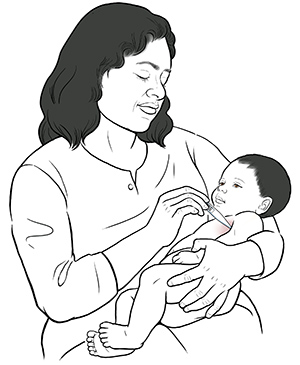
An armpit (axillary) temperature is taken by holding the thermometer under your baby's arm. To give a correct reading, this must be done with care. Armpit temperatures are a good screening for a child of any age. But they're not the most accurate way to take your child's temperature. Use the steps on this handout as a guide.
Getting the thermometer ready
-
Be sure to use a thermometer that's for armpit use.
-
Clean the thermometer before and after each use.
-
Make sure the thermometer is at room temperature.
-
Remove the cover from the thermometer.
Positioning your baby
-
Hold your baby on your lap. Or lay your infant on their back on a firm surface.
-
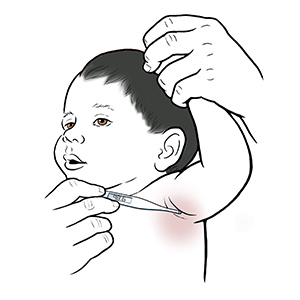
Grasp your baby's elbow. Gently but firmly lift the arm away from baby's side.
-
Place the tip of the thermometer in the fold of the armpit. To get a true reading, make sure the thermometer is against your baby's skin on all sides.
-
Bring the arm down next to the baby's side.
Taking the temperature
Follow the instructions for using your digital thermometer.
-
Keep your baby's arm against their side. This keeps the thermometer in place.
-
When the thermometer beeps, release your hold and gently lift your baby's arm. Remove the thermometer.
-
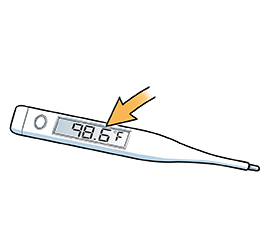
Read the temperature on the digital display. Normal temperature is around 98.6°F (37°C). But it can range from 97.6°F to 99.6°F (36.4°C to 37.6°C). Armpit temperatures can range from 0.5°F to 1°F (0.3°C to 0.6°C) lower than a rectal temperature.
-
Before putting the thermometer away, clean it with soap and warm water or alcohol.
-
When reporting the temperature to your baby's doctor, tell them that it was an axillary temperature reading.