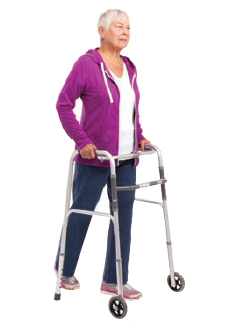
After hip replacement, you’ll likely use a walker to get around while you recover. There are a few types of walkers:
-
The standard nonrolling walker
-
The 2-wheeled (front) rolling walker
-
The 4-wheeled rolling walker
Your physical therapist or occupational therapist will teach you how to use a walker safely and help you choose the best one for you. Later, you may change from a walker to crutches or a cane.
Using a walker
-
Move the walker a few inches in front of you.
-
Lean on the walker so it supports you. Step into the center with your operated leg. Then step forward with your good leg. Repeat.
-
As you get more comfortable, you’ll be able to move the walker as you step.
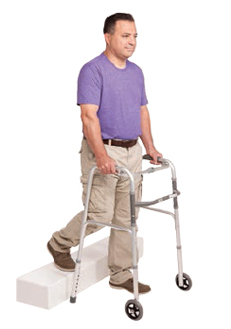
Walking up a curb
-
Move your feet and walker as close to the curb as possible.
-
Put your weight on both legs, and then lift the walker onto the curb.
-
Step on the curb with your good leg. Using the walker to support your weight, bring up your operated leg.
Walking down a curb
-
Move your feet and walker as close to the curb as possible.
-
Lower the walker onto the ground, keeping its back legs against the curb.
-
Using the walker to support your weight, lower your operated leg. Then step down with your good leg.
-
Never climb stairs or use an escalator with your walker.

Orthopedics CTA
Find a DoctorRelated Articles
Learning to Use a Prosthesis
Tips to help you learn to use a prosthesis.
AC Joint Sprain (Adult)
With an AC joint sprain, the ligaments that hold the collarbone to the shoulder blade may be partly or fully torn. In both cases this causes pain and swelling at the end of the collarbone.
After Hip Surgery: Mastering Daily Tasks
Read this for some tips about how to safely do your daily tasks after hip replacement surgery.
After Knee Replacement: Back at Home
You and your care team will evaluate how well you can care for yourself at home. You may need friends, family, or a home health aide to help with chores and errands.