Dismiss Modal

Types

Types of Brain Aneurysms

Choose a preferred language

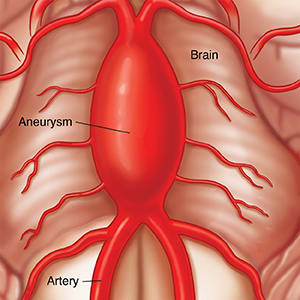
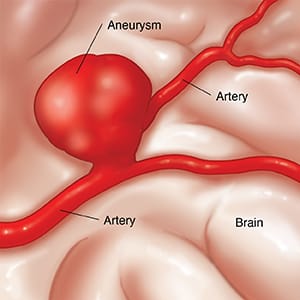
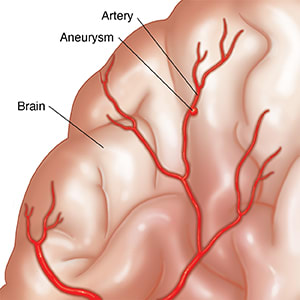
There are several types of brain aneurysms that are classified by shape. These are saccular (also called berry) aneurysms, which are by far the most common. Less common are the fusiform and dissecting types. Brain aneurysms may also be classified by:

  • Size (small, large, and giant)
  • Location
  • Cause (such as a mycotic aneurysm, caused by an infection)

Most aneurysms occur where an artery branches, often at the base of the brain. The risk of an aneurysm bursting (rupturing) can be affected by the shape and location of the aneurysm. The treatment choices vary, depending on the type of aneurysm, its size, and its location.
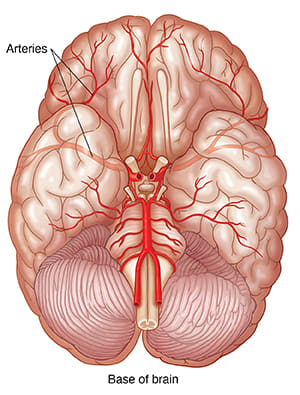
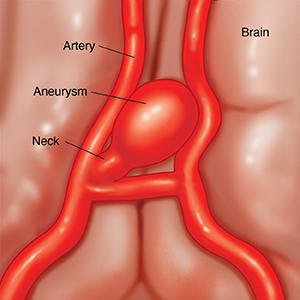
Brain viewed from bottom showing brain stem, cerebellum, and arteries.

Closeup of brain showing artery with saccular aneurysm.

Closeup of brain showing artery with fusiform aneurysm.

Closeup of brain showing giant aneurysm involving two arteries.

Closeup of brain showing mycotic aneurysm on artery.

Online Medical Reviewer: Chris Southard RN

Online Medical Reviewer: Marianne Fraser MSN RN

Online Medical Reviewer: Melinda Murray Ratini DO

Date Last Reviewed: 03/01/2024

© 2000-2026 The StayWell Company, LLC. All rights reserved. This information is not intended as a substitute for professional medical care. Always follow your healthcare professional's instructions.


Related Articles
Read article
Brain Health
What Is Peripheral Neuropathy?

Peripheral neuropathy is a disease of the nerves in your feet. It may make you unable to sense pain. Lack of pain makes you more likely to injure yourself without knowing it. But you can learn ways to protect your feet from injury.

Read article
Brain Health
Prion Diseases

Prion diseases comprise several conditions. A prion is a type of protein that can trigger normal proteins in the brain to fold abnormally. Prion diseases can affect humans and animals and are sometimes transmitted to humans by infected meat products.

Read article
Brain Health
What Is a Subdural Hematoma?

A subdural hematoma is a buildup of blood on the surface of the brain. The blood builds up in a space between the layers that surround your brain.

Read article
Brain Health
Post-Polio Syndrome

Learn details about post-polio syndrome, including causes, symptoms, diagnosis, and treatment.