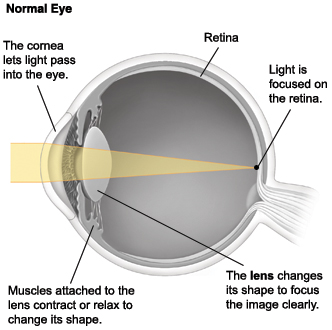
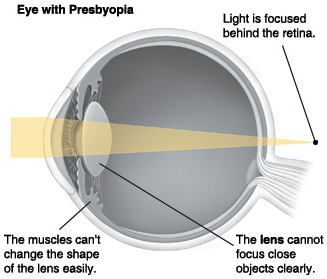
Presbyopia is the loss of close-up focusing. It's not a disease. It is a normal aging process of the eye. When you are younger, the lens in your eye changes shape to focus light directly on the back of your eye (the retina). But as you get older, the lens hardens and can't change its shape as easily. It then can’t focus clearly on close objects. This makes them look blurry.
What are the symptoms?
Presbyopia makes it hard to do things close-up. This includes reading small print, using tools, and threading a needle. The first sign may be a tired feeling when you look at something close-up. Presbyopia most often starts when you’re 40 to 45 years old. But it can start at an earlier age.
Online Medical Reviewer: Chris Haupert MD
Online Medical Reviewer: Raymond Kent Turley BSN MSN RN
Online Medical Reviewer: Rita Sather RN
Date Last Reviewed: 12/01/2022
© 2000-2026 The StayWell Company, LLC. All rights reserved. This information is not intended as a substitute for professional medical care. Always follow your healthcare professional's instructions.
Find Your Provider
Find a DoctorRelated Articles
Corneal Ulcer
A corneal ulcer is an open sore on your cornea. It's often caused by an infection.
Infected Tear Sac (Dacryocystitis)
Dacryocystitis is an infection of the tear sac. This can happen if the tear duct is blocked. Dacryocystitis can cause redness, swelling, and pain just below the lower lid, near the nose.
Retinal Detachment
With age, part of the retina can pull away from the blood vessels at the back of the eye, causing a loss of vision in the affected area. Eye surgery is needed to treat a retinal detachment.
Eye Bruise (Contusion)
An eye contusion (bruise) can cause pain and swelling around the eye. The skin may also change color.