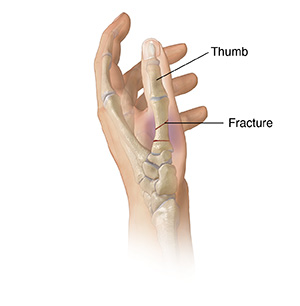
You have a broken (fractured) thumb. This causes pain, swelling, and often bruising in and around your thumb. This injury will usually take about 4 to 6 weeks or longer to heal. Thumb fractures may be treated with a splint or cast. This protects the thumb and holds the bone in place while it heals. More serious fractures may need surgery. This is done by an orthopedic surgeon. This is a surgeon who specializes in treating bone, muscle, joint, and tendon problems.
If the thumbnail has been severely injured, it may fall off in 1 to 2 weeks. A new thumbnail will often start to grow back within a month.
Home care
Follow these guidelines when caring for yourself at home:
-
Keep your arm elevated to reduce pain and swelling. When sitting or lying down, elevate your arm above the level of your heart. You can do this by placing your arm on a pillow that rests on your chest or on a pillow at your side. This is most important during the first 2 days (48 hours) after the injury.
-
Put an ice pack on the injured area. Do this for 20 minutes every 1 to 2 hours the first day for pain relief. To make an ice pack, put ice bags in a plastic bag that seals at the top. Wrap the bag in a thin towel. As the ice melts, be careful that the cast or splint doesn’t get wet. Keep using the ice pack 3 to 4 times a day for the next 2 days. Then use the ice pack as needed to ease pain and swelling.
-
If a splint was put on, leave this in place for the time advised. This will keep the bones from moving out of position.
-
Keep the cast or splint completely dry at all times. Bathe with your cast or splint out of the water. Protect it with a large plastic bag, rubber-banded or taped at the top end. If a fiberglass cast or splint gets wet, you can dry it with a hair dryer on a cool setting.
-
You may use acetaminophen or ibuprofen to control pain unless another pain medicine was prescribed. If you have chronic liver or kidney disease, talk with your provider before using these medicines. Also talk with your provider if you’ve had a stomach ulcer, digestive tract bleeding, or take a blood thinner.
-
Don’t put creams or objects under the cast if you have itching.
Follow-up care
Follow up with your health care provider as advised. This is to make sure the bone is healing the way it should. Talk with your provider about when it is safe to return to sports or work.
X-rays may be taken. You'll be told of any new findings that may affect your care.
When to contact your doctor
Contact your provider right away if:
-
The cast or splint cracks.
-
The plaster cast or splint becomes wet or soft.
-
The fiberglass cast or splint stays wet for more than 24 hours.
-
Bad odor comes from the cast or wound fluid stains the cast.
-
Your pain or swelling gets worse.
-
You have redness or warmth in the hand.
-
Your fingers or hand become cold, blue, numb, or tingly.
-
You can’t move your hand or fingers.
-
The skin around the cast or splint becomes red or swollen.
-
You have a fever of 100.4°F (38°C) or higher, or as advised by your provider.
-
You have chills.
Online Medical Reviewer: Raymond Turley Jr PA-C
Online Medical Reviewer: Stacey Wojcik MBA BSN RN
Online Medical Reviewer: Thomas N Joseph MD
Date Last Reviewed: 02/01/2025
© 2000-2026 The StayWell Company, LLC. All rights reserved. This information is not intended as a substitute for professional medical care. Always follow your healthcare professional's instructions.
Orthopedics CTA
Find a DoctorRelated Articles
Understanding Rotator Cuff Tendonitis
The rotator cuff connects the upper arm to the shoulder blade. It gives the shoulder joint stability and strength. Tendonitis happens when the tendons in the shoulder become irritated and swollen.
Understanding Neck Problems
Problems, such as poor posture, injury, and wear and tear, can lead to neck pain.
Understanding a Humerus Fracture
When you have a humerus fracture, it means that your upper arm bone is broken. Depending on the severity of the fracture, healing may take several months or longer.
Finger Dislocation
How to care for your finger after a dislocation.