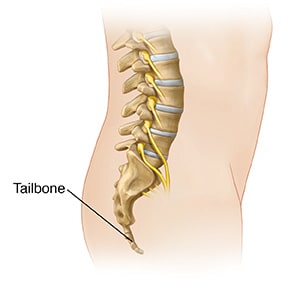
Your tailbone (coccyx) is the bone at the very end of your spine. Most tailbone injuries are caused by a seated fall or a direct blow. Often, the area around your tailbone is just bruised. But sometimes the bone itself may break (fracture). A tailbone fracture can be very painful and may take some time to heal.
Risk factors
People who are biologically female are more likely to injure their tailbones. That's because the tailbone is more exposed. Sometimes tailbones fracture during childbirth.
When to go to the emergency room (ER)
Tailbone injuries are likely to cause pain, swelling, and bruising. Sitting or having a bowel movement may be especially painful. Most tailbone fractures are not medical emergencies, though. In most cases you can go to your doctor for treatment.
But you should go to the emergency room (ER) if you have extreme pain, tingling, or weakness in one or both legs, or if you have trouble controlling your bowel or bladder.
What to expect in the ER
Here's what will happen in the ER:
- A doctor will examine your tailbone. This is done by pressing on the area and possibly gently inserting a gloved finger into your rectum.
- X-rays may be taken to check the extent of the injury.
- You may be given medicine to ease discomfort.
Treatment
There is no way to hold a fractured tailbone in place. For that reason, treatment focuses on making you more comfortable while the injury heals.
- You may be told to ice your injury for 1 or 2 days to help ease swelling and pain. To make an ice pack, put ice cubes in a plastic bag that seals at the top. Wrap the bag in a thin towel or cloth. Don't put ice or an ice pack directly on the skin.
- During healing, a special doughnut pillow or cushion may be advised for comfort. It can also protect your tailbone while you sit.
- Surgery may be needed if the above treatments don't work well.
Online Medical Reviewer: L Renee Watson MSN RN
Online Medical Reviewer: Raymond Turley Jr PA-C
Online Medical Reviewer: Thomas N Joseph MD
Date Last Reviewed: 02/01/2024
© 2000-2026 The StayWell Company, LLC. All rights reserved. This information is not intended as a substitute for professional medical care. Always follow your healthcare professional's instructions.
Orthopedics CTA
Find a DoctorRelated Articles
Understanding Cervical Strain
Cervical strain is a medical term for neck pain. The neck has several layers of muscles. These are connected with tendons to the cervical spine and other bones. Neck pain is often the result of injury to these muscles and tendons.
Knee Sprain of the Collateral Ligaments
You have a knee sprain. A sprain is a tearing of a ligament. Learn how to take care of a knee sprain at home.
Muscle Strain in the Extremities
A muscle strain is a stretching and tearing of muscle fibers.
Rib Contusion or Minor Fracture
A rib fracture (bone break) may cause the same symptoms as a rib contusion. Treatment for both is the same.